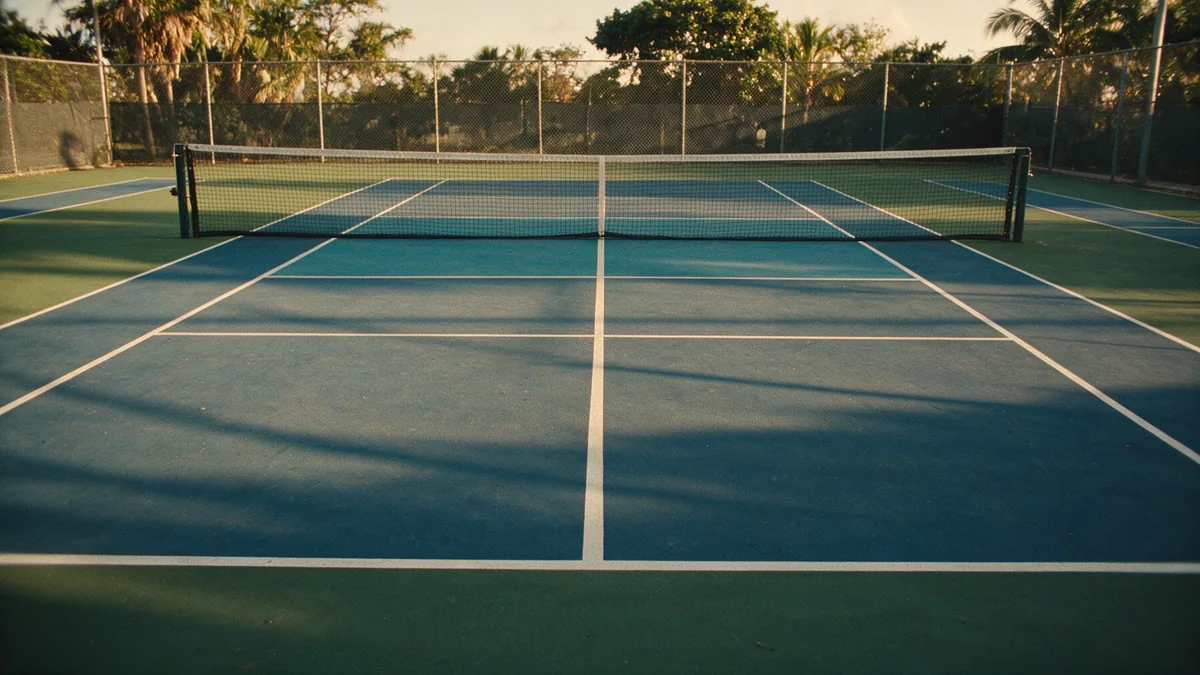
Only the serving side scores. In doubles the score is called as three numbers - your score, their score, then whether you are the first or second server - and a game is normally first to 11, won by two clear points. Every doubles game starts at 0-0-2, which is why the first serve sounds so strange.
Pickleball looks simple until somebody calls "two – five – one" and everyone stops. Scoring is the part that keeps new players quiet at the back of the court. This guide works through it the way it happens on court: who scores, why there are three numbers, which side you serve from, and what a whole game looks like written out. Every rule quoted below is from the 2026 USA Pickleball Official Rulebook.
The short version
- Only the serving side scores. Win a rally while receiving and you win the serve, not a point.
- Doubles scores are three numbers: your score, their score, then the server number — one or two.
- Every doubles game starts 0-0-2. The first serving team gets only one server in its opening turn.
- Even score, right side. In singles the server's own score decides which side they serve from; doubles has its own positioning rule.
- Games are normally to 11, win by two, with 15 and 21 also used in tournaments.
Who can score a point in pickleball?
Only the side that is serving. The USA Pickleball rulebook describes standard pickleball as a scoring method where points are scored only when the serving side wins the rally, and Rule 4.A puts it in one line: a point is scored by serving the ball and winning the rally. Win a rally while receiving and you win the serve, not a point.
This one rule explains why pickleball games swing the way they do. A team can win six rallies in a row while receiving and the scoreboard will not move. It is also why the serve matters more here than in a casual tennis game: serving is the only position from which you can score.
There is a newer alternative. The rulebook carries rally scoring as a provisionally approved option (Rule 14.A), in which a point is scored by the side that wins each rally. If someone insists every rally is a point, that is the format they mean — agree which one you are playing before you start.
What do the three numbers in a pickleball score mean?
The serving team's score, the receiving team's score, and the server number. Rule 6.B.2 of the USA Pickleball rulebook requires the doubles score to be called as three numbers in that order, so "four – two – one" means the serving team has four, the receiving team has two, and this is that team's first server.
"For doubles play, the score must be called as three numbers: serving team's score, then receiving team's score, then the server number. To start each game, the score will be called as ‘zero – zero – two.’" 2026 USA Pickleball Official Rulebook, Rule 6.B.2
Singles has no third number, because there is nobody else to serve. Rule 6.B.1 keeps singles to two numbers, server's score then receiver's score, and a singles game starts at "zero – zero".
The third number is the one that confuses people, and it is worth saying what it is for. When a doubles team wins the serve, both partners serve before the serve passes back — the rulebook's words are that both players on a team will serve before a side out is declared. The server number says which of those two turns is being played: "one" means the team still has a second server in reserve, "two" means the serving side's next fault hands the serve over.
Why does pickleball start at 0-0-2?
Because the team serving first gets only one server in its opening turn. Rule 5.B of the USA Pickleball rulebook makes the start of each game the exception, when only the starting server will serve as second server before a side out is declared, and Rule 6.B.2 has every game called as "zero – zero – two". It keeps the first turn short so serving first is not a two-server head start.
New players almost always call the first serve "zero – zero – one". Say "zero – zero – two", lose the rally, and the serve goes straight across the net.
Which side of the court do you serve from?
In singles, the score decides it. Rule 5.A.1 of the USA Pickleball rulebook requires the serve to be made from the right serving area into the opponent's right service court when the server's score is zero or even, and from the left when it is odd. Doubles has its own rule: under Rule 5.B.3 it is the starting server whose position follows the team's score, and that player's partner stands on the other half of the court.
| Singles server's score | Serve from | Ball goes to |
|---|---|---|
| 0, 2, 4, 6… (even) | The right serving area | The opponent's right service court, cross-court |
| 1, 3, 5, 7… (odd) | The left serving area | The opponent's left service court, cross-court |
This is why partners seem to swap halves constantly during a good serving run. Rule 5.A.2 has a player continue to serve, alternating right and left serving areas after each point won, until the rally is lost. Lose the rally and nobody swaps.
How does the serve pass to the other team?
Through the second server. In doubles, the rulebook defines the second server as the first server's partner, who serves after the first server loses serve. When the second server's turn ends, the serve goes to the opposition — a side out, which the rulebook defines as the awarding of the serve to the opposing team after a side loses its serve.
Written as a sequence, one doubles turn looks like this:
- Server one serves, alternating sides while the team keeps scoring.
- Server one loses a rally. No point to the other side, but the serve moves to the partner.
- Server two serves, again alternating sides while the team scores.
- Server two loses a rally. Side out: the serve crosses the net.
The exception is the start of the game, where the first serving team has only its second server.
What does a whole game look like, called out loud?
It looks like a short conversation that repeats. Below is the opening of a doubles game between the Lims and the Tans, with the call before every serve and the reason it changed. Reading one worked sequence teaches the three numbers faster than any explanation of them.
| Call | What happens | Why the call changes |
|---|---|---|
| 0-0-2 | Lims serve, and lose the rally | Start of the game: the serving team has only its second server |
| 0-0-1 | Tans serve and win the rally | Side out. The Tans start with their first server, their score first |
| 1-0-1 | Tans serve again and lose the rally | A point, so the server swaps to the other side and serves on |
| 1-0-2 | Second Tan serves and loses the rally | Same team, second server. Their next lost rally ends the turn |
| 0-1-1 | Lims serve | Side out. The Lims' score now leads the call |
Two habits fall out of that table. The serving side always says its own score first, so the same game reads differently depending on who is holding the serve. And a side out never changes anybody's score — only who is allowed to add to it.
How many points do you need to win a pickleball game?
Normally 11, and you have to win by two. The rulebook describes the typical game as the first player or team scoring 11 points and leading by at least a two-point margin, and Rule 4.B says the first side to score the winning point wins the game. Tournament formats also use games to 15 and 21.
The win-by-two rule is why a game that looks finished at 10–9 can run another ten minutes. At 10–10, somebody has to go two clear.
The two rules that decide the rally before the score does
The two-bounce rule and the non-volley zone. Under the two-bounce rule the receiver must let the serve bounce before returning it, and then the serving side must let that return bounce too. The non-volley zone is the area extending seven feet (about 2.13 m) from the net on each side, within which a player may not hit the ball out of the air before it bounces.
- The two-bounce rule. The serve bounces, the return bounces, and only then can anyone volley.
- The non-volley zone. The first seven feet from the net cannot be used for volleying.
How to get the call right without thinking about it
Say the score out loud before every serve, even in a friendly game. Rule 6.B of the USA Pickleball rulebook says the score must not be called until the server and receiver are in position and all players are ready, and that the server normally calls it; the habit is what makes three numbers automatic. It also prevents arguments, because a score called out loud is a score both sides have heard.
Three things make it stick faster:
- Call it before you bounce the ball, not while you serve. The call comes first, then the serve.
- Say your own score first, always. The serving side's score always leads the call.
- Keep one person calling. The rulebook has the same player call the score throughout the game, with one exception — if that player's voice becomes impaired, the partner may take over.
At a casual session, nobody is refereeing. Players call their own score, their own lines and their own faults, and a group that calls clearly plays faster and argues less. If you are joining a social game in the Klang Valley for the first time, being able to call the score is what lets you take your turn without holding the game up.
If you are still choosing a sport rather than learning to score one, our guide on pickleball, padel or tennis and which to start with is the better place to begin, and the rest of the Court Sense guides cover the other questions new players ask.
Frequently asked questions
Can you score a point on the other team's serve?
No. Points are scored only when the serving side wins the rally. Winning a rally while receiving wins you the serve, not a point — which is why pickleball scores move more slowly than the rallies suggest.
What do the three numbers in a pickleball score mean?
The serving team's score, the receiving team's score, and the server number — one or two. "Six – three – two" means the serving team has six, the receiving team has three, and the team is on its second server, so the next fault hands the serve over.
Why does pickleball start at 0-0-2?
Because the team that serves first gets only one server in its opening turn. The rulebook makes the start of each game the exception to both partners serving, and has every game called as "zero – zero – two", so serving first is not a head start.
How many points do you need to win a pickleball game?
Normally 11, and you must lead by at least two. Tournament play also uses games to 15 and 21.
Which side do you serve from in singles pickleball?
The server's own score decides. Serve from the right side when your score is zero or even, and from the left when it is odd, hitting cross-court into the service court diagonally opposite. Doubles has a separate positioning rule built around the starting server.
Sources
- 2026 USA Pickleball Official Rulebook — Rule 4.A (standard scoring) and 4.B (winning the game); Rule 5.A.1 and 5.A.2 (singles positions and holding serve); Rule 5.B and 5.B.3 (doubles serving sequence and positions); Rule 6.B.1 and 6.B.2 (calling the score in singles and doubles, and the 0-0-2 start); Rule 6.B.2.a (who calls the score); Rule 14.A (the provisional rally scoring option); Rule 15.C.1 (tournament game formats); and the rulebook's Unique Features summary of the two-bounce rule and the non-volley zone. Definitions of second server and side out are from Section 2.