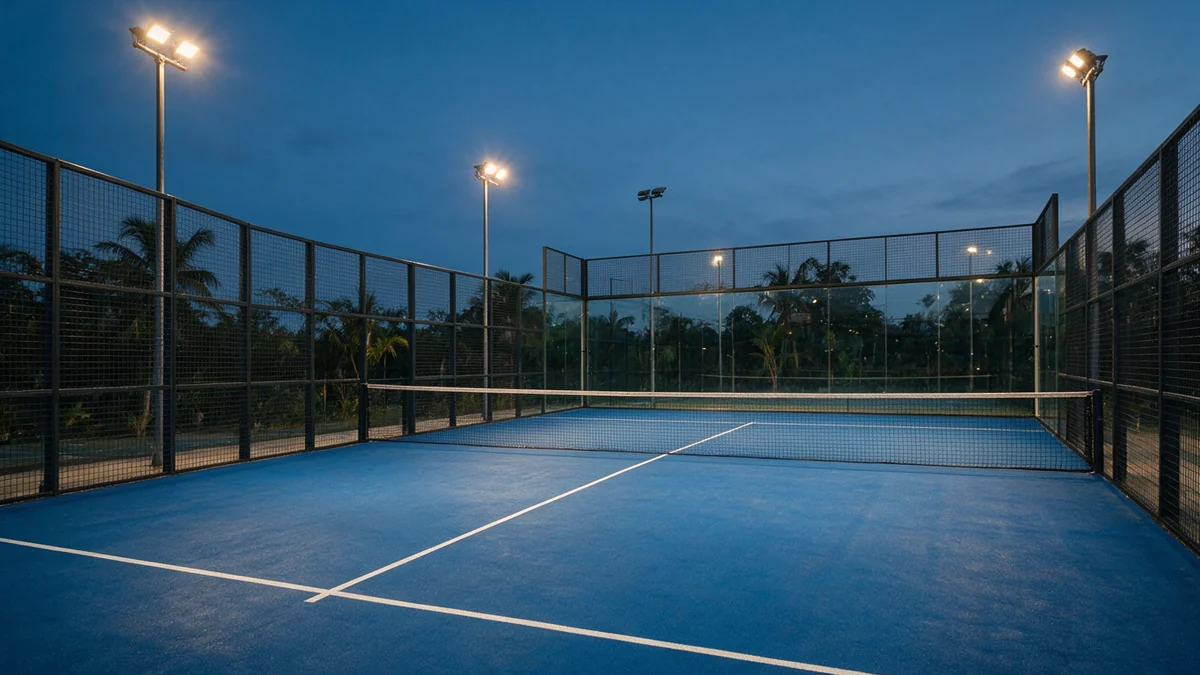
For a beginner with no particular goal, pickleball is the one to start with: it has the smallest court of the three, and its drop serve lets you bounce the ball and hit it with no restriction on height. Start with padel if you want a game in pairs on an enclosed court where the ball stays live off the walls. Start with tennis if tennis is the goal.
Pickleball, padel and tennis are three separate sports with three separate governing bodies and three separate rulebooks, and all three are coached in the Klang Valley by Court Sense. The courts are different sizes, the serves obey different rules, two of them share a scoring system and one does not, and one of them is played off walls. What follows sets them side by side using what those rulebooks say, so you can choose before you spend anything on equipment.
| Pickleball | Padel | Tennis | |
|---|---|---|---|
| Court | 6.10 × 13.41 m (20 × 44 ft) | 10 × 20 m, enclosed | 23.77 × 8.23 m singles; 10.97 m wide for doubles |
| Net at the centre | 86.36 cm (34 in) | 0.88 m | 0.914 m |
| Net at the ends | 91.44 cm (36 in) | 0.92 m | 1.07 m at the posts |
| What you hit with | Rigid paddle, length plus width up to 60.96 cm | Perforated frame, no strings, up to 45.5 cm | Strung racket |
| Serve | Volley serve with the ball no higher than the waist, or a drop serve with no height limit | Bounce it first, strike at or below the waist | Strike it before it hits the ground |
| Scoring | Normally to 11 points, win by 2 | 15, 30, 40, deuce; six games a set | 15, 30, 40, deuce; six games a set |
| Format | Singles or doubles, same court | Pairs | Singles or doubles |
The short version
- Smallest court: a pickleball court is 20 feet by 44 feet (6.10 m by 13.41 m), the same for singles and for doubles.
- Only enclosed court: a padel court is 10 m by 20 m, with walls and fencing that stay in play.
- Biggest court: a tennis court is 23.77 m long and 10.97 m wide for doubles.
- Pickleball's drop serve: it has no restriction on the height of contact, how many times the ball bounces first, or where on the surface it bounces.
- Different scoring: pickleball games are normally to 11 points, win by 2. Padel and tennis both use 15, 30, 40, deuce and advantage.
- Choose by the court you can get to. Equipment is the easy part.
Which racket sport is easiest for a beginner to start with?
Pickleball, on two counts that are written into its rulebook. A pickleball court is 20 feet by 44 feet (6.10 m by 13.41 m) for singles and doubles alike, so there is less ground to cover than on a tennis court. And pickleball allows a drop serve: the server drops the ball and hits it after it bounces, with no restriction on how many times it bounces or where on the playing surface it bounces.
Pickleball's other service motion, the volley serve, is the restricted one. On a volley serve the server's arm must be moving in an upward arc, the highest point of the paddle head must be clearly not above the highest part of the server's wrist joint, and the ball must be clearly no higher than the server's waist at contact. A beginner who does not want to think about any of that can use the drop serve instead.
Pickleball also has a rule that slows the start of every point. Under the two-bounce rule, the serve and the return of serve must each bounce before being returned: the receiver must let the serve bounce, and then the serving side must let the return bounce. Neither side can volley the first two balls.
Padel's serve is also restricted: the server bounces the ball on the ground first and must strike it at or below waist level with at least one foot in contact with the ground. What padel asks of you instead is a court. It needs a purpose-built enclosure.
How big is a pickleball court compared with padel and tennis?
A pickleball court is 20 feet by 44 feet, or 6.10 m by 13.41 m. A padel court is 10 m wide by 20 m long and enclosed on all sides. A tennis court is 23.77 m long and 8.23 m wide for singles, widening to 10.97 m for doubles.
The pickleball court
A pickleball court is one size for both formats. A pickleball net is 36 inches (91.44 cm) high where it crosses the outer edge of the sidelines and 34 inches (86.36 cm) at the centre point. The distinctive feature is the non-volley zone, which extends 7 feet from the net on each end of the court and inside which a player may not hit the ball out of the air before it bounces.
The padel court
A padel net is 0.88 m high at the centre, rising to 0.92 m at the ends. A padel court's service lines run parallel to the net 6.95 m away on each side. The court is enclosed: the ends are 4 m high in total, the first 3 m of which is wall — any transparent or solid material such as glass or brick — and the last 1 m metallic fence. The rules require a minimum height of 6 m throughout the court.
The tennis court
A tennis net is suspended from posts 1.07 m high and held down to 0.914 m at the centre. A tennis court's service lines are 6.40 m from each side of the net. Unlike the other two, a tennis court changes size with the format: the doubles alleys add 1.37 m on each side, taking the width from 8.23 m to 10.97 m.
What are the serve rules in pickleball, padel and tennis?
In tennis the server releases the ball by hand in any direction and hits it with the racket before it hits the ground. Padel requires the ball to bounce first and be struck at or below waist level. Pickleball allows either — a volley serve struck below the waist, or a drop serve after one or more bounces with no height limit.
Pickleball. On the volley serve, three things must all be true at contact: the arm is moving in an upward arc, the highest point of the paddle head is clearly not above the highest part of the server's wrist joint, and the ball is clearly no higher than the server's waist. On the drop serve, the server must release the ball from a natural, unaided height and must not propel it, and Rule 7.D sets no restriction on contact height, on the number of bounces or on where the ball bounces. Either serve may be forehand or backhand, and both go diagonally crosscourt.
Padel. The server stands with one foot behind the service line and must bounce the ball on the ground inside the box they are serving from before striking it. Contact must be at or below waist level, and at least one foot must be in contact with the ground. The serve travels diagonally over the net into the receiver's service box, and a player who misses the first serve is allowed a second.
Tennis. Before the motion starts the server stands at rest with both feet behind the baseline, then releases the ball by hand in any direction and hits it with the racket before the ball hits the ground. The rule permits a serve struck above the head and does not require one.
How is the scoring different in pickleball, padel and tennis?
Padel and tennis share a system; pickleball uses its own. In padel and tennis, points are called 15, 30, 40 and game, with deuce at three points each and advantage after it, and a set goes to six games with a margin of two. Pickleball games are normally played to 11 points, win by 2, and under traditional side-out scoring only the serving team can score.
Pickleball tournament games may be played to 15 or 21, still win by 2. Rally scoring, where the winner of each rally scores whether or not they served, is a provisionally approved option in the rulebook rather than the default.
Padel's standard scoring follows tennis closely: the first pair to win six games with a minimum advantage of two wins the set, 5-all is played out to 7-5, 6-all goes to a tie-break, and a match is the best of three sets. The FIP rules also set out alternative scoring methods, so check which one a club or a tournament is using.
What makes padel different from pickleball and tennis?
The enclosure, and the racket. If a padel ball in play hits any part of the court after having bounced in the opponent's ground, it stays in play and must be returned before it bounces a second time — the insides of the walls, the fence, the ground, the net and the net posts all count as parts of the court. And a padel racket has no strings: it is a perforated frame, head and handle together no longer than 45.5 cm and no wider than 26 cm, with a wrist cord whose use the rules make obligatory.
A pickleball paddle, by comparison, must be made of rigid, non-compressible material, with a combined length and width of up to 24 inches (60.96 cm) and a length of up to 17 inches (43.18 cm); the rules set no limit on its thickness or weight. Tennis is the only one of the three played with a strung racket.
How many players do you need for each?
Pickleball is played as singles or doubles on the same court, and USA Pickleball says doubles is the most common format. Padel's rules are written throughout for pairs: a server, a receiver, and each of their partners. Tennis is played as singles or doubles, on a court that is wider for doubles.
If finding three other people every week is the hard part, that is a reason to weigh pickleball or tennis over padel, both of which have a singles format in their rules.
Does playing tennis help you learn pickleball or padel?
The scoring transfers between padel and tennis almost completely, since both use 15, 30, 40, deuce and advantage with six games to a set. The serves transfer least: pickleball restricts its volley serve to contact at or below the waist, and padel requires a bounce first, so the tennis service motion is not legal in either.
Court positioning is the other thing that does not carry over. A padel court is enclosed and 10 m wide; a tennis doubles court is 10.97 m wide and open, so the ball that a padel pair plays off the back wall is simply out in tennis. Between pickleball and tennis, the non-volley zone has no equivalent in tennis at all.
There is no rule that says you have to pick one for life.
How do you start pickleball, padel or tennis in the Klang Valley?
Choose the sport by the court you can realistically reach each week, then arrange a first session before you buy anything. Court Sense coaches pickleball, padel and tennis in the Klang Valley, and sessions are arranged over WhatsApp on +60 13-340 8183: you say which sport you want to try, and a time and a court are agreed from there.
Borrow or hire a racket for the first session if you can. A padel racket is not legal equipment for pickleball and a pickleball paddle is not a tennis racket, so each sport is a separate purchase.
Court Sense coaches complete beginners as well as players who already play and want to improve, adults and children, one to one or in small groups. If you are undecided between the three, say so when you message. More guides are collected on the Guides page.
Frequently asked questions
Is pickleball easier than tennis for a complete beginner?
In two respects set by the rules, yes. A pickleball court is 20 feet by 44 feet (6.10 m by 13.41 m) against a tennis court's 23.77 m length, so there is less ground to cover. And pickleball allows a drop serve, where the ball is dropped and struck after it bounces with no restriction on contact height, while a tennis serve must be struck before the ball hits the ground.
Can padel be played on a tennis court?
No. Padel's rules describe a purpose-built enclosure: a 10 m by 20 m court whose ends are 4 m high, the first 3 m of which is wall and the last 1 m metallic fence, with a minimum height of 6 m throughout. The walls are part of the game — a ball that hits them after bouncing in the opponent's ground is still in play — so a court without them is not a padel court.
Is padel scored like tennis?
Under its standard method, yes: 15, 30, 40 and game, with deuce when both pairs reach three points and advantage after it. A set goes to the first pair to win six games with a margin of two, 6-all is settled by a tie-break, and a match is the best of three sets. The FIP rules also set out alternative scoring methods, so check which one is in use.
Do pickleball and padel use the same racket?
No. A pickleball paddle must be made of rigid, non-compressible material, with a combined length and width of up to 24 inches (60.96 cm). A padel racket is a perforated frame with no strings, no more than 45.5 cm long in total and no more than 26 cm wide, and it must carry a wrist cord, which the rules make obligatory.
Which of the three has an overhead serve?
Tennis's rules permit a serve struck above the head: the server releases the ball by hand and hits it before it touches the ground, with no limit on contact height. Padel requires the ball to bounce first and be struck at or below waist level. Pickleball's volley serve must be struck with the ball no higher than the server's waist and the paddle head below the wrist; its drop serve has no height limit but, like padel's, is played after a bounce.
Sources
- 2026 USA Pickleball Official Rulebook — court and net dimensions (3.A.1, 3.B.6, 3.B.7), the non-volley zone, the two-bounce rule (10.A), the volley serve (7.C), the drop serve (7.D), paddle specifications (3.D), ball construction (3.C.5), side-out scoring and rally scoring as a provisionally approved option (14.A).
- USA Pickleball, Essential Pickleball Rules Summary — games to 11 win by 2, tournament games to 15 or 21, points scored only by the serving team, and doubles as the most common format.
- International Padel Federation, Rules of Padel (review of application 1 January 2026) — court and net dimensions, the enclosure, the ball, the racket, Rule 1 Score in a Game and its alternative methods, Rule 3 Position of the Players, Rule 6 The Serve and Rule 12 Ball in Play.
- International Tennis Federation, Rules of Tennis 2026 — Rule 1 The Court, Rule 3 The Ball with Appendix I, Rule 5 Score in a Game, Rule 6 Score in a Set and Rule 16 The Service.