The doubles game played off the glass
Padel coaching in the Klang Valley
The short answer
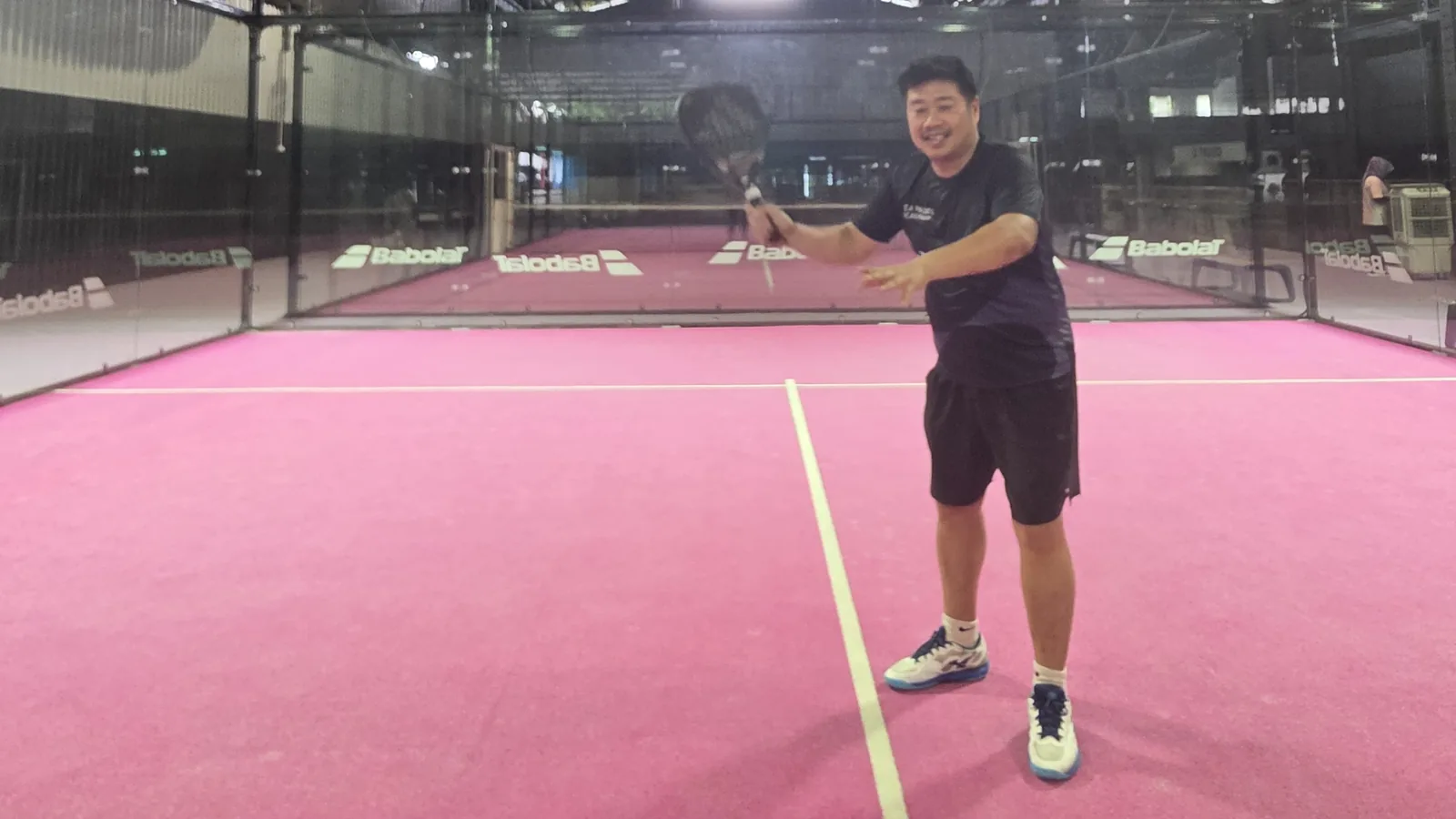
Court Sense coaches padel in the Klang Valley with George Cheah, certified by PadelMBA and SEA PADEL. Padel is usually played in doubles on a 20 × 10 m enclosed court, where the ball stays in play off the glass once it has bounced. Most newcomers, tennis and squash players included, find the walls, the underarm serve and moving as a pair the new parts. Message George on WhatsApp.
- The game
- Usually doublesTwo against two
- Coach
- George CheahPadelMBA, SEA PADEL
- Area
- Klang ValleySelangor and Kuala Lumpur
- Contact
- WhatsApp+60 13-340 8183
How does padel differ from pickleball and tennis?
A padel court is 20 × 10 m, enclosed by 4 m end walls: 3 m of glass topped by 1 m of metal fence, with more glass and mesh along the sides.
How do the walls work in padel?
In padel, once the ball has bounced on your side it may hit any of your walls, glass or fence, and stay in play, as long as you return it before it bounces a second time. A shot that hits the opponents' walls or fence before bouncing in their court loses the point, so every ball you send must land in their court first. You may also hit the ball into your own wall, the contrapared, to get it back over the net. The fence rebounds far less predictably than the glass.
How does the serve work in padel?
The padel serve is underarm. The server bounces the ball first, then strikes it at or below waist height with at least one foot on the ground, diagonally into the receiver's box, and gets a second serve if the first fails. A serve that clips the net and lands in the box is a net serve and is replayed, unless the ball then touches the metallic fence; a serve that bounces in the box and then hits the fence is a fault. The overhead tennis serve is not allowed.
How is padel scored?
Padel uses tennis scoring: points go 15, 30, 40 and game, with deuce at 40-40 and then advantage, or a single deciding golden point where the competition uses one; the FIP rules also offer a star point. The first pair to six games, two clear, wins the set, and at six games all a tie-break decides it, first to seven points by two. A match is the best of three sets.
Our guide to how the walls work in padel takes each wall rule in turn.
| Measure | Padel |
|---|---|
| Court | 20 × 10 m, enclosed on all four sides |
| Each end | 4 m high: 3 m of wall, usually glass, then 1 m of metal fence |
| Net | 0.88 m at the centre, 0.92 m at the ends |
| Service line | 6.95 m from the net |
| Racket | 45.5 cm at most, head and handle; stringless, with an obligatory wrist cord |
Source: International Padel Federation, Rules of Padel. Rules checked against the FIP Rules of Padel (December 2025 edition); page reviewed .
On this page8
Who is padel coaching for?
Your coach is George Cheah, who coaches as Court Sense. He is certified by PadelMBA and SEA PADEL, and plays padel tournaments as well as coaching. He runs one-to-one private sessions, semi-private sessions for 2 to 4 people, group clinics, and corporate or team-building sessions, on weekday mornings and evenings, and weekends, by booking (more about George). He coaches in Shah Alam, Petaling Jaya, Kota Damansara and Balakong in Selangor, and in Bandar Sri Damansara in Kuala Lumpur, with other places by arrangement (where George coaches). Padel is often a second racket sport, so the most useful thing to tell George is what you already play. This is what usually carries over from each sport, and what will be new.
| Coming from | What carries over | What is new |
|---|---|---|
| Badminton | Overheads (the smash, the clear, the drop) and quick hands at the net. | Letting the ball bounce: every opponent's shot must bounce before it comes off your glass. Then the walls, and a solid racket. |
| Tennis | The 15, 30, 40 scoring, and much of your volleying at the net. | The walls, a more compact swing and an underarm serve: the overhead tennis serve is not legal in padel. |
| Squash | Reading a ball as it comes back off a wall. | The ball must bounce on your floor before it comes off your glass, and padel is usually played as a pair. |
| Pickleball | Quick hands and reflexes at the net. | The lob-and-overhead game: the lob, or globo, to win the net back, and overheads such as the bandeja. |
Coming from tennis or pickleball? There is more on tennis coaching and pickleball coaching. Four more starting points:
- Complete beginners
- If you are new to racket sports, padel needs no other sport first: the serve is underarm, after a bounce, which keeps the start simple.
- Pairs and ready fours
- Padel is usually played two against two, so say in your message whether you have a partner, or a full four, who wants to learn too.
- Returning players
- If you played padel before and stopped, say roughly when, and how comfortable you were playing off the walls.
- Parents asking for a child
- George coaches juniors as well as adults, including junior programmes in schools and academies. Say your child's age, and ask from what age he takes a child at padel.
What you can ask George to work on
You agree the focus with George; nothing here is a fixed programme. Padel players commonly ask about three parts of the game:
At the back
- Playing the ball off the back glass and the side glass, including balls that come off two walls.
- The lob, or globo, to win back the net.
- The chiquita: a soft, low ball at the feet of the pair at the net.
- Using your own wall, the contrapared, when you are under pressure.
At the net
As a pair
- Moving together: up to the net and back again as one.
- Who takes the ball down the middle, and calling it.
Every term here is defined in the glossary, and our guide to how the walls work in padel explains the wall rules behind them.
What to tell George in your first message
The example is a first message for a pair of tennis players new to padel; change it to fit you. What each blank, and anything you add, tells George:
- Your level, in plain words: never played, a few games, or playing weekly.
- Other racket sports you play: badminton, tennis, squash or pickleball.
- Your partner situation: on your own, with one partner, or a ready four.
- Your preferred Klang Valley area, or the court you already use.
- Days and times that suit you, and whether your partners have fixed days.
- Your goal: games with friends, joining a league, or fixing one shot such as your bandeja.
What happens next: George replies on WhatsApp to agree the court, the format and a time for a first session.
A first message for a pair
Hi Court Sense, I'm enquiring through your website (courtsense.com.my). I'd like padel coaching for ____ of us. We play ____ but are new to padel. We're in ____ and free on ____.
Replace the blanks before you send. Other ways to reach George are on the contact page.
Open it in WhatsAppWhat to bring to a padel session
For a first padel session, these help:
- Padel shoes, and clothes you can move inMany padel courts are artificial grass with sand on top, where running shoes slip. A herringbone (omni-court) sole grips better.
- A racket, if you own oneIf you do not, ask George whether he can lend one for a first session before you buy. The FIP rules make the wrist cord obligatory, so wear it.
- Padel ballsThey look like tennis balls but have lower pressure. Ask whether balls are provided.
- Water and a towelKlang Valley courts can be warm and humid, roofed or not.
- A cap and sunscreenFor an open-air court.
What to ask George before you book
Court Sense coaches padel in the Klang Valley. The price, the session length and the court booking are not published on this site: George confirms them with you on WhatsApp. Ask about the ones that matter to you; his usual venues are on the About page.
Padel words you will hear on court
One line each; the glossary has the full definitions, and the words the three sports share.
- La pared (the wall)
- Playing the ball after it has bounced on your side and come back off your own glass, before its second bounce.
- Bandeja (tray)
- A controlled overhead with slice, usually in reply to a lob, played to keep the net rather than to win the point outright.
- Víbora (viper)
- An overhead with heavy sidespin and more pace than the bandeja, aimed to skid low off the side glass.
- Bajada (descent)
- An attacking shot hit downwards out of the air after the ball has come high off the back glass.
- Chiquita
- A soft, low shot from the back that dips at the feet of the pair at the net, so they have to volley upwards.
- Globo (lob)
- A high ball over the pair at the net, aimed deep: the usual way for the pair at the back to win the net.
- Por tres
- A smash hit so hard that, after bouncing, the ball leaves the court over the walls.
- Golden point
- At deuce, 40-40, one deciding point settles the game, and the receiving pair chooses the side to receive on. One of three FIP scoring options, with advantage and the star point.
Rule-based terms (la pared, por tres, golden point): International Padel Federation, Rules of Padel.
Padel questions before your first session
Three short answers here, then two guides that go further.
How long does it take to learn padel?
Many beginners can keep a short padel rally going in a first session, because the serve is underarm and the court is small. Playing the ball off the back and side glass, and moving as a pair, take far longer: expect months of regular games. Our guide to how the walls work in padel covers the hardest part.
Do I need a partner to learn padel?
A partner helps, since padel is usually played in doubles, two against two, but you can enquire on your own. Say in your message whether you have a partner or a ready four, and ask George whether he can pair you up if you come alone.
Is padel easier than tennis to start?
Padel is usually quicker to start than tennis: the serve is underarm after a bounce, the court is 20 × 10 m against tennis's 23.77 m length, and the racket is short and stringless. The walls are the new part for tennis players. Pickleball, padel or tennis: which to start with compares all three.
How do the walls work in padel?
Each wall rule in turn: when the glass is in play, when the fence is, and when a ball off the walls loses the point.
Read the guidePickleball, padel or tennis: which first?
The three sports side by side: the court, the serve, the scoring and the kit, and who each suits.
Read the guideStart with one message
Tell George your level, whether you have a partner or a four, and where in the Klang Valley you would like to play.
WhatsApp Court Sense