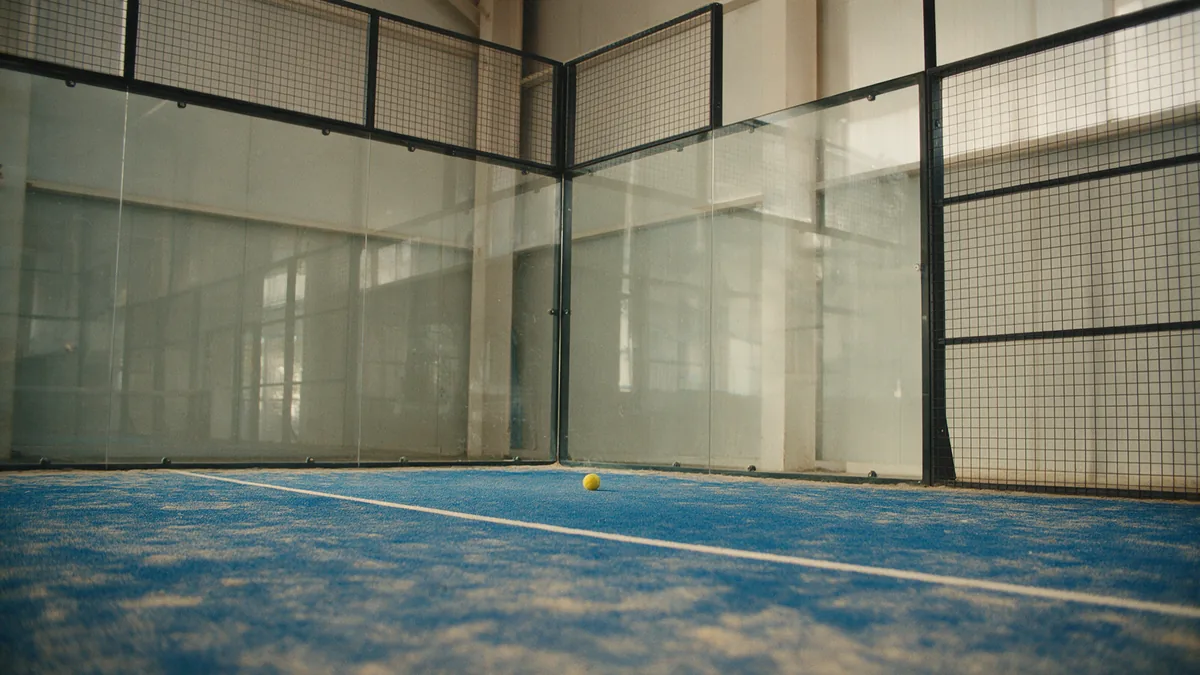
In padel, the glass walls are part of the court. Once the ball has bounced on your side, it stays in play if it then hits the glass or the mesh fence, and you can return it before it bounces a second time. You may also play the ball into your own glass so it carries over the net, but a shot that hits the opponents' walls or fence before bouncing loses the point.
Padel is usually played in doubles on a court enclosed by glass and mesh. This guide sets out what the International Padel Federation’s Rules of Padel (the edition applied from 1 January 2026) say about the walls, so you know before your first session which rebounds are yours to play and which end the point.
The short version
- Bounce first, then the walls. After a ball bounces on your side it can hit the glass or the fence and you still play it, before its second bounce.
- Your own glass is usable. You may hit the ball into your own wall so it carries over the net.
- Your own fence is not. A shot that touches the metallic fence on your own side loses the point.
- Never straight into their walls. A shot that hits the opponents’ glass or fence without bouncing first loses the point.
- On the serve, the fence is a fault. A serve may come off the glass after bouncing, but not off the mesh.
On this page10
Can you hit the ball off the wall in padel?
Yes. In padel, a ball that bounces on your side and then comes off the glass is still yours to play before its second bounce, and you may play the ball into your own glass so it carries over the net. You may not hit the opponents’ walls or fence before the ball has bounced in their court. The short version above sums it up.
Each of those comes straight from the official rulebook, and the table further down gives the rule numbers. According to Wikipedia’s history of padel, Enrique Corcuera invented it in 1969 in Acapulco, Mexico, after he modified his squash court, and balls “can be played off the court walls, similar to squash.”
What happens when the ball hits the glass after bouncing?
When the ball bounces on your side and then hits the glass, it stays in play. The FIP rules treat the walls, the mesh fence, the ground, the net and the net posts all as parts of the court, so a rebound off any of them after the bounce is still live, and you return it before it bounces on the ground a second time.
“If the ball in play hits any part of the court after having bounced in the opponent’s ground, it will remain in play and should be returned before it bounces for the second time.” — International Padel Federation, Rules of Padel, Rule 12
In practice, a ball that has passed you is not lost: it can come back off the back glass and you can still reach it before the second bounce. A ball that lands right in the angle where the wall meets the ground is also a correct return under Rule 14.
Can you hit the ball into your own wall?
Yes, into your own glass. Rule 14 says a return is correct when the ball hits the wall in your own court first and then bounces in the opponents’ court. Rule 13 says you lose the point if your shot touches the metallic fence or the ground on your own side, so the glass on your side can be used to get the ball back over the net, while the mesh cannot.
The ball still has to clear the net and land in the opponents’ court like any other return. If it touches the mesh on your side on the way, the point is lost.
Glass or fence: why does the difference matter?
The difference matters because the rules treat them differently. After the ball has bounced in a player’s court, a rebound off the glass or the fence is still in play. But your own shot must not touch the fence on your side, and on the serve the fence is a fault. A ball that leaves through a hole in the fence, or sticks in it, wins the point for the player who hit it.
The FIP rules describe the enclosure in detail. The court is 10 metres wide and 20 metres long inside. At each end, the enclosure is 4 metres high: “the first 3 m of which is wall” (glass, brick or another material) and “the last 1 meter is metallic fence”. Along the sides, one layout steps the wall down from 3 metres to 2 metres high at each end, with mesh filling the centre; the other has a 3-metre-high glass section, 4 metres long, at each end, with mesh above and between. The rules require joins that give a uniform bounce, and describe the areas with metal fencing as places where “the bounce is not uniform”.
| Situation | Result | Rule |
|---|---|---|
| Ball bounces on your side, then hits the glass or fence | Still in play: return it before the second bounce | 12 and 14 |
| You hit the ball into your own glass and it crosses the net | Correct return, if it then bounces in their court | 14 |
| Your shot touches the fence or the ground on your own side | You lose the point | 13 |
| Your shot hits their glass or fence before bouncing | You lose the point | 13 |
| After bouncing in their court, the ball goes through or sticks in the fence | You win the point | 15 |
| A serve bounces in the box, then touches the fence | Fault | 7 |
What are the wall rules on the serve?
On the serve, the ball must bounce in the receiver’s service box first. The serve faults the rules list include a ball that, after bouncing in the box, touches the metallic fence before its second bounce. The server bounces the ball first, strikes it at or below waist level, and keeps one foot behind the service line.
The official rules say the server must “bounce the ball on the ground to serve” and hit it with the ball “at or below the waist level”, with at least one foot in contact with the ground, and serve diagonally into the receiver’s box. If the first serve is not valid, a second is allowed. The receiver lets the serve bounce in the box and returns it before the second bounce, and from there the rally runs on the wall rules above.
When can a player leave the court to play the ball?
A player may leave the court to chase a ball only on a court built for it. The FIP rules allow out-of-court play when the court has the access points and clear safety area the rules describe. Without that, a ball that leaves the court after bouncing ends the rally.
On a court without the safety area, the rules count it as a point lost when the ball, after bouncing, goes over the outer limit of the court or through the gate. It is worth asking at a venue whether its courts allow out-of-court play.
How do beginners learn to play off the walls?
Padel’s walls are learned by letting the ball come to you. A player used to tennis or badminton may want to hit the ball before it reaches the glass; under padel’s rules the rebound can be waited for, as long as you play it before its second bounce.
For a broader start, our guide to choosing between pickleball, padel and tennis sets out the courts, serves and scoring side by side.
Learning padel in the Klang Valley with Court Sense
Court Sense coaches padel, pickleball and tennis in the Klang Valley, for complete beginners and for players who already play and want to improve. Lessons are arranged on WhatsApp: you message to agree the sport, a time and a court.
Message Court Sense on WhatsApp (+60 13-340 8183) to arrange one; more on padel lessons is on the padel coaching in the Klang Valley page, and the other guides are on the guides page.
Frequently asked questions
Can you hit the ball off the wall before it bounces?
Not into the opponents' walls. Under the FIP rules your shot must bounce in the opponents' court before it touches their glass or fence, or you lose the point. You may volley their shot before it bounces, and a shot of yours that clips the net or post and then lands in their court is still a correct return.
Is it still in play if the ball hits the fence after bouncing?
Yes. If your opponents' shot bounces on your side and then hits the metallic fence or one of the walls, it is still in play under the International Padel Federation rules: return it before it bounces again. On a rally, the fence ends the point if your own shot touches it on your side, or if your shot hits the opponents' fence before bouncing.
Can a padel serve hit the glass?
A serve must bounce inside the receiver's service box. It is a fault if, after bouncing in the box, it touches the metallic fence before its second bounce.
What happens if the ball gets stuck in the fence?
The player who hit it wins the point. The FIP rules say a point is won if, after bouncing in the opponent's court, the ball goes out through a hole in the metallic fence or gets stuck in it, or gets stuck on the flat top of the wall.
Can you hit the ball into your own back wall in padel?
Yes. A return is correct if it hits the wall in your own court first and then bounces in the opponents' court. A ball that lands in the corner, where the wall meets the ground, also counts as a correct return under the FIP rules.
Sources
- International Padel Federation, Rules of Padel (review of application 01.01.2026) — court dimensions and enclosure, Rule 6 The Serve, Rule 7 Serve Fault, Rule 8 Return of Serve, Rule 9 Net Serve, Rule 12 Ball in Play, Rule 13 Point Lost, Rule 14 Correct Return, Rule 15 Point Won, Rule 16 Authorized Out-of-Court Play.
- Wikipedia, “Padel” — doubles as the usual format, the 1969 invention in Acapulco by Enrique Corcuera, and play off the walls “similar to squash”.