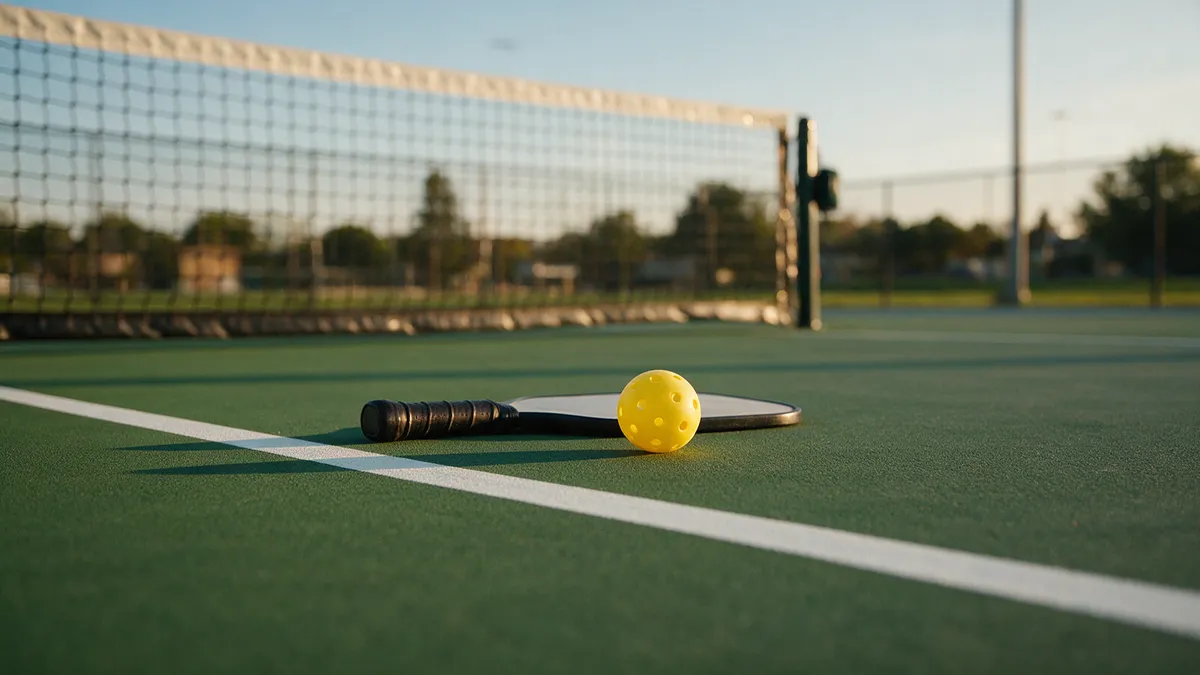
The kitchen is the nickname for pickleball's non-volley zone: the area that extends 7 feet (2.13 m) from the net on each side of the court, lines included. You may not volley, that is hit the ball out of the air, while you or anything touching you is in that zone. You may stand in the kitchen at any time and play a ball there once it has bounced.
The kitchen rule decides when you are allowed to volley near the net. This guide follows the 2026 USA Pickleball Official Rulebook, Section 11 and the definitions behind it, so you know what counts as a fault before your first game.
The short version
- Where: the 7-foot (2.13 m) by 20-foot (6.08 m) area beside the net on each side, lines included.
- What is banned: volleying while you, your paddle, your partner or anything touching you is in the zone.
- What is allowed: standing in the kitchen at any time, and playing a ball there after it bounces.
- Momentum counts: if a volley carries you into the kitchen afterwards, it is still a fault.
- Getting out: after being in the kitchen, both feet must be back outside it before you volley.
On this page10
Where exactly is the kitchen on a pickleball court?
The kitchen sits on both sides of the net. The rulebook defines it as the 7-foot by 20-foot (2.13 m by 6.08 m) area of the court adjacent to each end of the net, with its line running parallel to the net 7 feet away, between the two sidelines. All the lines that bound it are part of the zone.
The rulebook adds that the non-volley zone “is two-dimensional and does not extend above the playing surface.” In other words, the kitchen is the painted area on the ground, not the air above it, which matters when you reach forward to volley a ball.
What does the kitchen rule actually say?
The kitchen rule says every volley must start outside the non-volley zone. In the words of Rule 11.A: “All volleys must be initiated outside of the non-volley zone. A player, or anything in contact with the player, may contact the non-volley zone at any time except during the act of volleying a ball.”
A volley is “a strike of the ball before the ball bounces.” So the rule is not about where the ball is or where you stand in general; it is about touching the zone while you are hitting the ball out of the air.
What counts as a kitchen fault?
Section 11 lists three kitchen faults. It is a fault if a volleying player, or anything touching them, contacts the zone; if a volleying player’s momentum carries them into contact with the zone or anything touching it; and if a player who has been in the zone volleys before both feet are completely back outside it.
| Fault | What happens | Rule |
|---|---|---|
| Contact while volleying | You, your paddle, or anything in contact with you (your partner included) touches the zone during a volley | 11.A.1 |
| Momentum | After a volley, your momentum makes you touch the zone, or anything touching it, even after the ball is dead | 11.A.2 |
| Failure to exit | You volley before both feet are completely outside the zone after being in it | 11.A.3 |
Can you go into the kitchen at all?
Yes. You may walk into the kitchen, stand in it and play balls there whenever you are not volleying. A ball that has bounced can be hit from inside the kitchen. The only restriction is on volleys: touch the zone while volleying, or volley before both feet are out again, and it is a fault.
Wikipedia’s summary of the rules puts it the same way: a player “may enter the non-volley zone to play a ball that has bounced and may stay there to play other balls that bounce,” but must have both feet outside the zone again before playing a volley.
How does momentum cause kitchen faults?
Momentum causes kitchen faults because the act of volleying does not end when the ball leaves your paddle. The rulebook says the act of volleying lasts until the player’s movement from the follow-through stops, and that momentum ends when the player regains balance and control or stops moving toward the zone.
So a volley played close to the line can still become a fault a moment later, if you stumble forward onto the line or into the kitchen. Rule 11.A.2 says this is a fault “even after the ball becomes dead”. It also covers touching anything in contact with the zone, which includes your partner if they are standing in it.
Does the kitchen rule apply to the serve?
The kitchen affects the serve in a different way. Under Rule 7.E, the served ball must clear the opponent’s non-volley zone and land in the correct service court; a serve that lands in the kitchen, including on its line, is a fault against the server.
The two-bounce rule also keeps the opening of every rally off the volley: the serve and the return of serve must each bounce before being returned. Our guide to how pickleball scoring works covers the serve and the score calls, and the Court Sense glossary explains terms such as the kitchen and the dink.
Who calls kitchen faults?
Under Rule 9.B.3 of the 2026 rulebook, players may call non-volley zone faults and service foot faults on an opponent. Rule 9.B.3.a says the fault should be called as soon as it is committed or detected, and must be called before the serve that starts the next rally. If the two teams disagree about the call, the rally is replayed.
Rule 9.B.2 also expects players to call faults on themselves or their partner as soon as the fault is committed or detected, and Rule 9.B.3.c says a disagreement between partners on a fault call is decided in favour of their opponents.
Learning pickleball in the Klang Valley with Court Sense
Court Sense coaches pickleball, padel and tennis in the Klang Valley, for complete beginners and for players who already play and want to improve, in one-to-one and small-group sessions for adults and children. Lessons are arranged on WhatsApp: you message to agree the sport, a time and a court.
More on pickleball lessons is on the pickleball coaching in the Klang Valley page. Message Court Sense on WhatsApp (+60 13-340 8183) to arrange one, and see the guides page for the other guides, including how long it takes to learn pickleball.
Frequently asked questions
Can you stand in the kitchen in pickleball?
Yes. The 2026 USA Pickleball rulebook says a player may contact the non-volley zone at any time except during the act of volleying a ball. You can stand in the kitchen, and play a ball there after it bounces. What you cannot do is volley while touching the zone.
Is the kitchen line part of the kitchen?
Yes. Under Rule 3.A.4.c, all lines that bound the non-volley zone are part of the zone. A volleying player whose foot touches the kitchen line has touched the kitchen, and it is a fault. The serve, too, is a fault if it lands on the kitchen line.
Can you hit a volley over the kitchen?
Yes, as long as nothing touching you contacts the zone. The rulebook describes the non-volley zone as two-dimensional: it does not extend above the playing surface.
Can you go into the kitchen after you hit a volley?
Not while your momentum from that volley is still carrying you. The act of volleying lasts until the player regains balance and control or stops moving toward the zone. If that momentum makes you touch the kitchen, or anything touching it, it is a fault against you, even after the ball is dead.
Why is it called the kitchen?
The rulebook does not say. It only uses the name non-volley zone; Wikipedia notes that, unofficially, the zone is commonly referred to as "the kitchen". Players use both names for the same area, and the same rules apply whichever name you use.
Sources
- USA Pickleball, 2026 Official Rulebook — definitions (non-volley zone, volley, act of volleying, momentum, two-bounce rule), Rule 3.A.4.c court specifications, Rule 7.E serve placement, Rule 9.B.3 calling faults, Rule 10.A two-bounce rule, Section 11 non-volley zone infractions.
- Wikipedia, “Pickleball” — the “kitchen” nickname and the summary of when players may enter the non-volley zone.