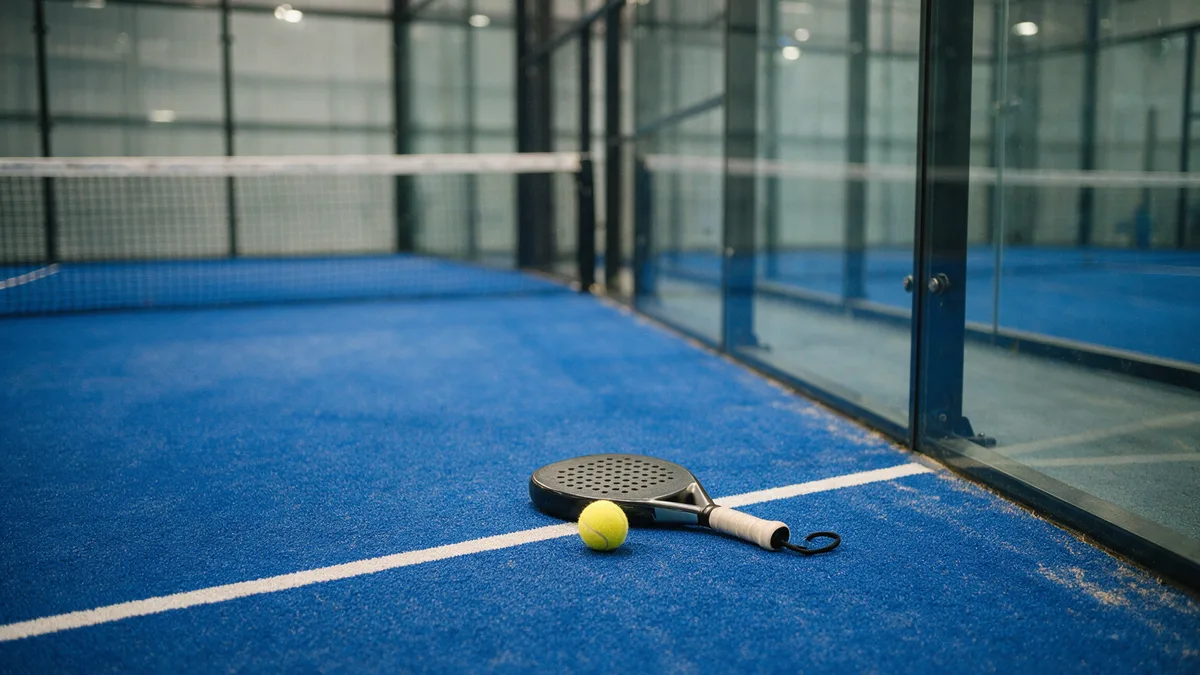
A padel serve is hit at or below the waist: under the International Padel Federation rules, the server stands behind the service line, bounces the ball inside their own service box, and hits it at or below waist height with at least one foot on the ground. The ball must cross the net diagonally and bounce in the receiver's service box. A server who faults on the first serve gets a second.
Every padel point starts with the serve, and its rules are short but strict. This guide follows the International Padel Federation Rules of Padel (the review applied from 1 January 2026), Rules 4 and 6 to 9, so you know what makes a serve good or a fault.
The short version
- Where you stand: one foot behind the service line, inside your service box, not touching the lines.
- How you hit: bounce the ball in your own box, then hit it at or below the waist, one foot on the ground.
- Where it goes: diagonally over the net into the receiver's box; the lines count as in.
- Two serves: if the first is not valid, you get a second.
- Net serve: touches the net and lands in the box? The serve is repeated.
On this page9
Where do you stand to serve in padel?
To serve in padel, you stand with one foot behind the service line, in the box between the imaginary extension of the central service line and the side wall, and you stay there until the ball is served. Rule 6.3 says the server may not touch the service line with their feet, nor the imaginary central line.
The server also needs at least one foot in contact with the ground when the ball is hit (Rule 6.4). Serving from the wrong side is corrected as soon as it is discovered; under Rule 6.7, the points already played still count, but a fault on the first serve is taken into account.
How do you hit a padel serve?
To hit a padel serve, bounce the ball on the ground inside the box you are serving from, then strike it at or below waist level. Rule 6.2 says the server must bounce the ball to serve, and that the ball may not cross the service line or the imaginary central line until it is struck. Rule 6.4 sets the waist-height limit.
Under Rule 6.6, the serve counts from the moment contact is made with the ball, or from an intentional attempt to hit it. That is why missing the ball completely when you try to hit it is a fault (Rule 7.1.b), not a free retry.
| Part of the serve | The rule | FIP rule |
|---|---|---|
| Feet | One foot behind the service line, lines not touched | 6.1, 6.3 |
| Bounce | Ball bounced inside your own box | 6.2 |
| Height | At or below the waist when hit | 6.4 |
| Ground contact | At least one foot on the ground | 6.4 |
| Direction | Diagonally into the receiver's box | 6.5 |
| Attempts | Second serve if the first is not valid | 6 |
Where must a padel serve land?
A padel serve must pass diagonally over the net and bounce inside the receiver's service box, within the lines that bound it. Rule 7.1.c makes a serve that bounces outside the box a fault, and states that the lines are counted as good, so a serve that lands on the line is in.
Rule 6.5 sets the order: the ball is served from the right side, and in the first instance it goes diagonally into the receiver's box on their left; when a point is won, the next serve goes into the box on the receiver's right, and so on, alternating. The box changes with every point, so both players on the receiving side face the serve in turn.
What counts as a service fault in padel?
A padel serve is a fault if the server breaks any of the serving rules on stance, bounce, line contact, waist height or direction, misses the ball, or if the ball lands outside the receiver's box. It is also a fault if the ball hits the server or their partner, or touches the metal fence before its second bounce, under Rule 7.
- Breaking Rule 6, points 1 to 6: stance, bounce, foot on the line, ball above the waist, wrong direction.
- Missing the ball when trying to hit it.
- Bouncing outside the receiver's box (the lines are good).
- Hitting the server or their partner, or anything they wear or carry.
- Touching the metallic fence after bouncing in the box and before the second bounce.
- Bouncing out of the court through a gate where out-of-court play is not allowed.
The glass walls are a different matter from the fence: a serve that bounces in the box and then hits the glass is not on the Rule 7 fault list, which names the metallic fence. Our guide to how the walls work in padel explains playing off the glass once the rally starts.
What happens if the serve touches the net?
If a padel serve touches the net or its posts and then lands in the receiver's service box, without touching the metal fence before the second bounce, it is a "net" and the serve is repeated, under Rule 9. A let on the first serve repeats the whole point, so the server again has two serves; a net or let on the second serve repeats only the second serve.
A serve is also repeated, a "let", if it is played before the receiver is ready (Rule 6.10). The rules balance this both ways: under Rule 6.11, a receiver who tries to return the serve cannot then claim they were not ready.
How does the return of serve work?
The receiver must let the serve bounce inside their service box and hit it before it bounces a second time, under Rule 8.1. If the served ball hits a receiving player or their racket before it bounces, Rule 8.5 gives the point to the server.
Under Rule 8.2 and 8.3, the receiving pair decide in the first game of each set who receives first; that player receives the first serve of every game in the set, and the two receive in turn. A coin toss settles the choice of sides and of serving or receiving at the start of the match (Rule 4.1), and once a pair has set its serving order for a set, it stays the same until the next set (Rule 6.8). How the points then add up is in our guide to how padel scoring works.
How do you learn a reliable padel serve?
A coach can check the parts of the serve the rules are strict about: where your feet are, where you bounce the ball and how high you strike it. Court Sense coaches padel, pickleball and tennis in the Klang Valley. Message Court Sense on WhatsApp (+60 13-340 8183) to arrange a session, and see the padel coaching page or the guides page for more, including whether to start with pickleball, padel or tennis.
Frequently asked questions
Is the padel serve underhand?
The rules do not use the word underhand. Rule 6.4 of the International Padel Federation rules says the ball must be at or below waist level at the moment it is hit, and Rule 6.2 says the server must bounce it on the ground first.
How many serves do you get in padel?
Two. The FIP rules say that if the first service is not valid, the server is allowed a second service.
What happens if a padel serve hits the net?
If the serve touches the net or the posts and then lands in the receiver's service box, without touching the metal fence before the second bounce, it is a "net" and the serve is repeated (Rule 9). A net or let on the second serve repeats only the second serve.
Can a padel serve hit the glass?
Rule 7's fault list names the metallic fence, not the glass: a serve that bounces in the box is a fault if it then touches the metallic fence before its second bounce, or bounces out of the court through a gate where out-of-court play is not allowed.
Are the lines in or out on a padel serve?
In. Rule 7.1.c says a serve is a fault if the ball bounces outside the receiver's service box, and that the lines are counted as good.
Where can I learn padel with a coach in the Klang Valley?
Court Sense coaches padel, pickleball and tennis in the Klang Valley. Message +60 13-340 8183 on WhatsApp to arrange a session.
Sources
- International Padel Federation, Rules of Padel (review of application 1 January 2026) — Rule 4 (choice of sides and service), Rule 6 (the serve), Rule 7 (serve fault), Rule 8 (return of serve), Rule 9 (repeat or "let" and "net" serve).