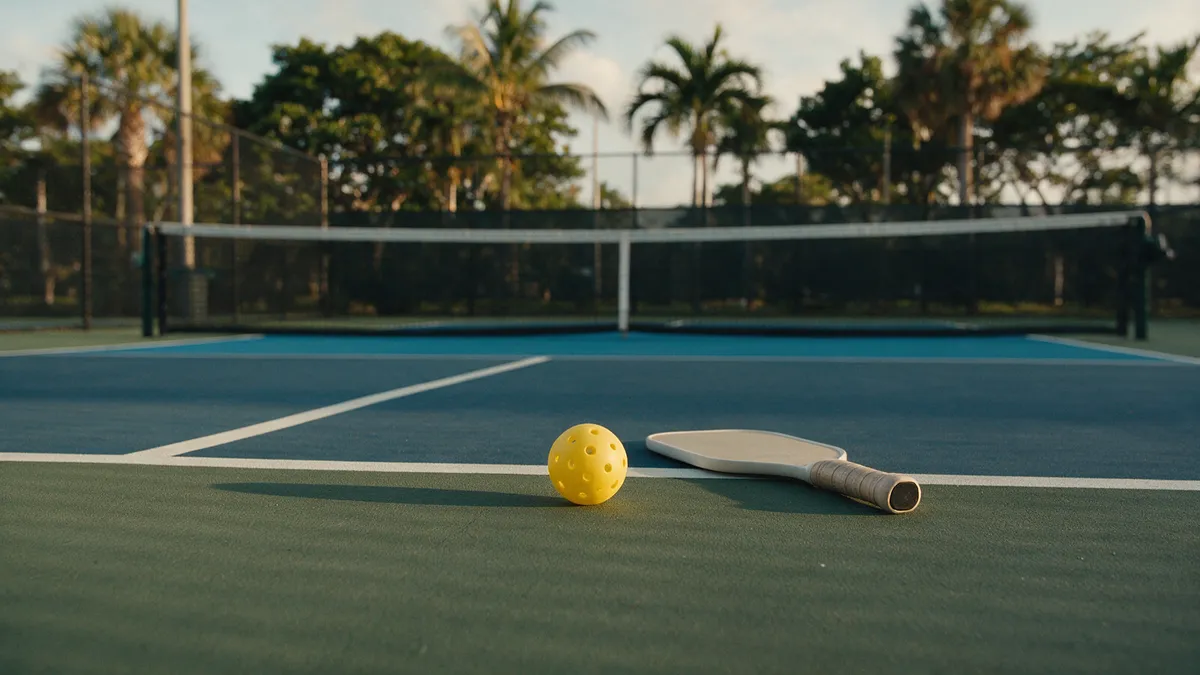
The two-bounce rule in pickleball says the serve and the return of serve must each bounce before being hit. The receiving side lets the serve bounce, then the serving side lets the return bounce. After those two bounces, players may volley, hitting the ball out of the air, as long as they do it from outside the non-volley zone.
Key takeaways
- The serve must bounce before the receiver hits it.
- The return of serve must bounce before the serving side hits it.
- Hitting the serve or the return of serve before it bounces is a fault.
- After the two bounces, players may volley, but only from outside the non-volley zone.
- A ball that bounces twice on your side before you hit it is a separate fault, called a double bounce.
On this page8
What is the two-bounce rule in pickleball?
The two-bounce rule in pickleball is the rule that the serve and the return of serve must each bounce before being returned. The 2026 USA Pickleball Official Rulebook lists it as one of the sport's "unique features": "After the serve, the receiver must allow the ball to bounce before making their first return, and then the serving team must allow the ball to bounce before making their first return."
The rule is Rule 10.A in the 2026 USA Pickleball Official Rulebook, published by USA Pickleball, the National Governing Body of American pickleball. Its own words are short: "The serve and the return of serve must each bounce before being returned."
How does the two-bounce rule work, shot by shot?
The two-bounce rule works across the first three shots of every rally: the serve bounces on the receiver's side, the return bounces on the serving side, and from the fourth shot on, either side may hit the ball before or after it bounces.
| Shot | Who hits it | Must it bounce first? |
|---|---|---|
| 1. Serve | Server | Lands on the receiver's side |
| 2. Return of serve | Receiver | Yes: the receiver lets the serve bounce |
| 3. Third shot | Serving side | Yes: the serving side lets the return bounce |
| 4. Every shot after | Either side | No: a volley is allowed, from outside the non-volley zone |
In doubles, Rule 10.A.2 names "the server or server's partner".
What is a fault under the two-bounce rule?
A fault under the two-bounce rule is hitting the serve or the return of serve before it bounces. The rulebook sets out one fault for each side.
- No bounce by receiver (Rule 10.A.1): "When the receiver does not allow the serve to bounce before hitting the ball, it is a fault against the receiver."
- No bounce by serving side (Rule 10.A.2): "When the server or server's partner does not allow the return of serve to bounce before hitting the ball, it is a fault against the serving side."
How a fault changes the score depends on who served and on the scoring system in use; our guide to how pickleball scoring works explains the three numbers that are called before each serve.
When can you volley in pickleball?
You can volley in pickleball once the serve and the return have each bounced, and only from outside the non-volley zone. The rulebook defines a volley as "a strike of the ball before the ball bounces", and the non-volley zone as the area that "extends 7 feet from the net on each end of the court".
Rule 11.A says: "All volleys must be initiated outside of the non-volley zone." A player may step into the zone at other times, but not while volleying a ball. Our guide to the kitchen rule explains the non-volley zone in detail.
Is the two-bounce rule the same as a double bounce?
No: the two-bounce rule and a double bounce are different things. The two-bounce rule says the first two shots must each bounce once. A double bounce is a fault: the rulebook defines it as "when the ball bounces twice on one end of the net before it is returned".
Rule 10.B says "a player must return the ball before a second bounce", and Rule 10.B.1 makes a double bounce "a fault against the player". The rulebook makes one exception: players using wheelchairs and players with certain disabilities "may allow the ball to bounce twice before returning the ball", with the first bounce in the court.
How do beginners remember the two-bounce rule?
Beginners can remember the two-bounce rule as "bounce, bounce, then play": let the serve bounce if you are receiving, let the return bounce if you served, and only then think about volleying.
A simple habit helps: if your side served, stay back near the baseline until the return has bounced, so you are not tempted to hit it out of the air. Our guides to the pickleball serve rules and how long it takes to learn pickleball cover the next steps.
Court Sense coaches pickleball, padel and tennis in the Klang Valley. Message Court Sense on WhatsApp (+60 13-340 8183) to arrange a session.
Frequently asked questions
Is the two-bounce rule the same as the double-bounce rule?
No. The USA Pickleball rulebook uses the two names for two different things. The Two-Bounce Rule (Rule 10.A) says the serve and the return must each bounce. A Double Bounce is when the ball bounces twice on one side before it is returned, which is a fault (Rule 10.B.1).
What happens if you volley the serve in pickleball?
If the receiver hits the serve before it bounces, it is a fault against the receiver, under Rule 10.A.1 of the USA Pickleball rulebook.
What happens if the serving team volleys the return?
If the server or the server's partner hits the return of serve before it bounces, it is a fault against the serving side, under Rule 10.A.2.
When can you volley in pickleball?
After the serve and the return have each bounced, players may volley. Every volley must start outside the non-volley zone, the 7-foot area on each side of the net (Rule 11.A).
Where can I learn pickleball in the Klang Valley?
Court Sense coaches pickleball, padel and tennis in the Klang Valley. Message Court Sense on WhatsApp at +60 13-340 8183 to arrange a session.
Sources
- USA Pickleball, 2026 Official Rulebook — Unique Features; definitions of Double Bounce and Volley; Rule 10.A (Two-Bounce Rule), Rule 10.B (Maximum Number of Bounces) and Rule 11.A (Non-Volley Zone, Allowable Contact).