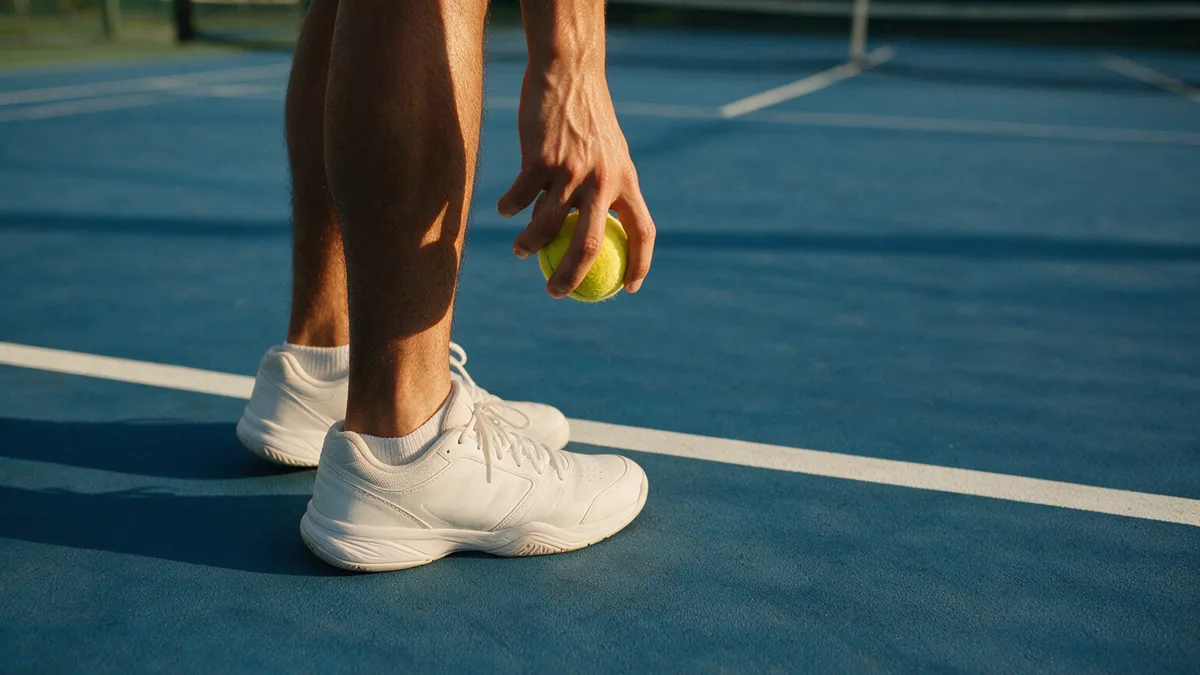
In tennis, the server stands behind the baseline, between the centre mark and the sideline, and must hit the ball over the net into the service court diagonally opposite. A serve that misses, or that breaks the foot-fault rule, is a fault; two faults in a row lose the point. A serve that clips the net and lands in is a let and is served again.
Key takeaways
- Where to stand: behind the baseline, between the centre mark and the sideline.
- Where it must land: in the service court diagonally opposite.
- Two chances: a first fault gives you a second serve; two faults in a row lose the point.
- Foot fault: touching the baseline or the court with either foot before you hit the ball.
- Let: a serve that touches the net and lands in is served again.
The rules quoted in this guide are the International Tennis Federation's Rules of Tennis, as printed in Tennis Canada's Rules of the Court 2026. The ITF publishes the rules on its rules and regulations page.
On this page8
Where do you stand to serve in tennis?
You serve from behind the baseline. Rule 16 says that before the service motion "the server shall stand at rest with both feet behind (i.e. further from the net than) the baseline and within the imaginary extensions of the centre mark and the sideline".
Rule 17 sets the side: in a standard game you serve from "alternate halves of the court, starting from the right half of the court in every game". In a tie-break game, the first serve is also from the right half. In singles, Rule 18, Case 1 says you may not stand behind the part of the baseline between the singles and doubles sidelines; in doubles you may.
Where must the serve land?
The serve must land in the service court diagonally opposite. Rule 17 says "the service shall pass over the net and hit the service court diagonally opposite, before the receiver returns it".
To serve, Rule 16 says the server "shall then release the ball by hand in any direction and hit the ball with the racket before the ball hits the ground". The serve is complete "at the moment that the player's racket hits or misses the ball".
What is a fault in tennis?
A fault is a serve that breaks the rules. Under Rule 19, the serve is a fault if the server breaks Rules 16, 17 or 18, or misses the ball when trying to hit it.
| What happens on the serve | Ruling | Rule |
|---|---|---|
| Lands outside the correct service court | Fault | 17, 19a |
| Swing and miss | Fault | 19b |
| Toss, then catch it without swinging | Not a fault | 19, Case 1 |
| Foot touches the baseline during the motion | Foot fault | 18b |
| Touches the net and lands in the correct court | Let: serve again | 22a |
| Hits the singles stick, then lands in | Fault | 19, Case 2 |
| Two faults in a row | Point lost (double fault) | 24a |
After a first fault, Rule 20 says "the server shall serve again without delay from behind the same half of the court". If that second serve is also a fault, Rule 24a applies: the point is lost if "the player serves two consecutive faults".
What is a foot fault in tennis?
A foot fault is breaking the footwork rule during the service motion. Rule 18 says the server shall not change position by walking or running, or touch the baseline or the court with either foot. Slight movements of the feet are allowed.
A foot fault is a fault like any other (Rule 19a): on a first serve you still have a second, and on a second serve it loses the point. Jumping is allowed: Rule 18, Case 2 says the server may have "one or both feet off the ground".
What is a let in tennis?
A let is a serve that does not count and is played again. Under Rule 22, a serve is a let if it touches the net, strap or band and is otherwise good, or if it is served before the receiver is ready. "That particular service shall not count, and the server shall serve again, but a service let does not cancel a previous fault."
So a let on a first serve gives you the first serve again, and a let on a second serve gives you the second serve again. Ask which rules apply before a match.
How do beginners practise the serve rules?
Beginners can practise the serve rules by building one routine: stand still behind the baseline, check which half you serve from, toss, and hit to the box diagonally opposite.
Count your first and second serves out loud in practice, so the "two chances" rule becomes a habit before match play. Our guides to how tennis scoring works and which racket sport to start with cover the next steps.
Court Sense coaches tennis, padel and pickleball in the Klang Valley. Message Court Sense on WhatsApp (+60 13-340 8183) to arrange a session.
Frequently asked questions
Can you serve underarm in tennis?
Yes. The Rules of Tennis only say the server must release the ball by hand and hit it before it hits the ground. Tennis Canada's note to Rule 16 adds that the server may use an underarm or overhead service.
Is it a fault if you toss the ball and catch it?
No. Under Rule 19, Case 1, a server who tosses the ball and decides not to hit it may catch it with the hand or the racket, or let it bounce. Swinging and missing, though, is a fault (Rule 19b).
Can you jump when you serve in tennis?
Yes. Rule 18, Case 2 says the server is allowed to have one or both feet off the ground.
Does a let cancel a first-serve fault?
No. Rule 22 says a service let "does not cancel a previous fault". If your first serve was a fault and your second serve is a let, you replay the second serve.
What is the No-Let rule?
An approved alternative in Appendix VI of the Rules of Tennis: a serve that touches the net, strap or band is in play instead of being replayed. Ask before a match which rules apply.
Where can I learn tennis in the Klang Valley?
Court Sense coaches tennis, padel and pickleball in the Klang Valley. Message Court Sense on WhatsApp at +60 13-340 8183 to arrange a session.
Sources
- Tennis Canada, The Rules of the Court 2026 — the ITF Rules of Tennis, Rules 16 (The Service), 17 (Serving), 18 (Foot Fault), 19 (Service Fault), 20 (Second Service), 22 (The Let During a Service), 24 (Player Loses Point) and Appendix VI ("No Let" rule).
- International Tennis Federation, Rules and Regulations.