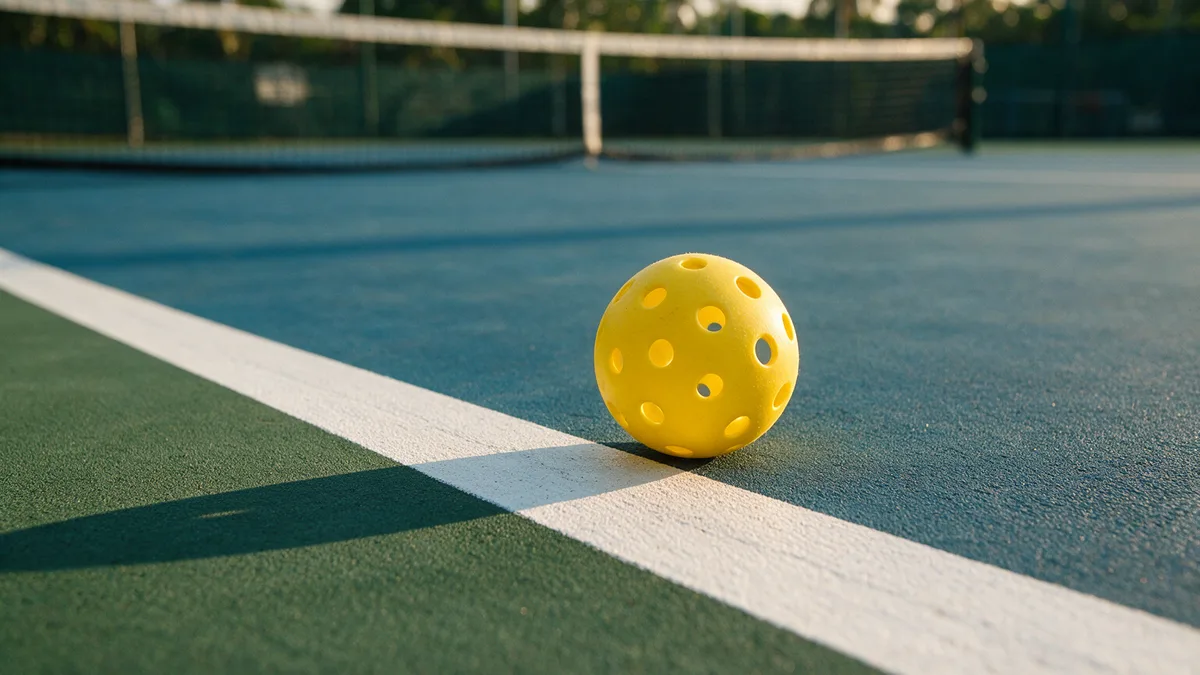
In pickleball, a ball that lands on a line is in, with one exception. Under the 2026 USA Pickleball rulebook, a returned ball that lands on the opponent's end of the court is in, and a ball may only be called out when you can clearly see a space between the line and the ball. The one exception is the serve: a serve that lands on the non-volley zone line is out.
Key takeaways
- On the line is in: a returned ball that touches the baseline or a sideline is in.
- Serve exception: a serve that lands on the kitchen line is out.
- See the gap: call a ball out only if you clearly saw space between it and the line.
- Doubt means in: any ball you cannot promptly call out is in.
- Your end, your call: players call the lines on their own end.
On this page7
Is a ball on the line in or out in pickleball?
A ball on the line is in, except for a serve on the kitchen line. Rule 8.B of the 2026 USA Pickleball rulebook says "a ball returned by a player that lands on the opponent's end of the court is 'in'", and Rule 8.E says players must not call a ball out "unless they can clearly see a space between the line and the ball when it lands".
So if any part of the ball touches the baseline or a sideline when it lands, there is no space to see, and the ball is in.
Is a serve on the kitchen line in or out?
A serve that lands on the kitchen line is out. Rule 8.C says a served ball that does not land in the correct service court, "including one that lands on the non-volley zone line, is 'out'". The serve must clear the non-volley zone line and land in the correct service court.
This is the one place where touching a line is out. The kitchen, or non-volley zone, is the area that extends 7 feet from the net on each side; our guides to the kitchen rule and the pickleball serve rules explain both in detail.
| Where the ball lands | Serve | Any other shot |
|---|---|---|
| Baseline | In, if it is the correct service court | In |
| Sideline | In, if it is the correct service court | In |
| Centreline | In, if it is the correct service court | In |
| Kitchen (non-volley zone) line | Out | In |
| Inside the kitchen (non-volley zone) | Out | In |
| Beyond the line, with a clear space between ball and line | Out | Out |
Who makes the line calls in pickleball?
The players make the line calls. Rule 8.A says "players are responsible for making 'out' calls for all lines on their end of the court", and in doubles either or both partners may make the call.
An out call is made "audibly by voice, visibly by a hand signal, or both" (Rule 8.F), and it ends the rally: "a line call results in a dead ball and play must stop" (Rule 8.F.2). Shouting to your partner while the ball is still in the air, such as "bounce it", is player communication, not a line call (Rule 8.F.4). Spectators must not be consulted on any call (Rule 8.J).
What if you are not sure whether the ball was in?
If you are not sure, the ball is in. Rule 8.D says "all questionable calls must be resolved in favor of the opponent", and "any ball that cannot be promptly called 'out' must be considered 'in'".
You also have two ways to settle a call fairly:
- Ask your opponent (Rule 8.I). Until the next serve, you may ask the opponent's opinion. A clear "in" or "out" from them stands; if they cannot say, your own call stands, or the ball is in if you made none.
- Overrule yourself (Rule 8.G). You may override your own call, your partner's call, or an "in" ruling, but only to your own disadvantage.
When doubles partners disagree, Rule 8.H settles it: "the team's call will be 'in'".
When must an out call be made?
An out call must be made promptly. Under Rule 8.F.3, if you return the ball, your out call must come before the opponent hits it or before the ball becomes dead, or play continues. If you let the ball go, a prompt out call counts even if the ball becomes dead first.
In practice, call early and clearly. If you are learning, it helps to practise the habit of calling only what you saw, which is also what the rulebook's code of ethics asks for. Our guide to how pickleball scoring works explains what happens to the score after a rally ends.
Court Sense coaches pickleball, padel and tennis in the Klang Valley. Message Court Sense on WhatsApp (+60 13-340 8183) to arrange a session.
Frequently asked questions
Is the baseline in or out in pickleball?
A ball that lands on the baseline or a sideline is in. The rulebook only allows an out call when a player can "clearly see a space between the line and the ball when it lands" (Rule 8.E).
Is a serve on the kitchen line in or out?
Out. A served ball that lands on the non-volley zone line, the kitchen line, is out under Rule 8.C. A serve must clear that line and land in the correct service court.
Who calls the lines in pickleball?
Players call the lines on their own end of the court (Rule 8.A). In doubles, either partner may make the call.
What happens if doubles partners disagree on a line call?
The ball is in. Under Rule 8.H, when partners disagree on a line call, "the team's call will be 'in'".
Can I ask my opponent to make a line call?
Yes, until the next serve is hit (Rule 8.I). If the opponent makes a clear call, it stands. After you ask, you and your partner lose the chance to make that call, except to rule in your opponent's favour.
Where can I learn pickleball in the Klang Valley?
Court Sense coaches pickleball, padel and tennis in the Klang Valley. Message Court Sense on WhatsApp at +60 13-340 8183 to arrange a session.
Sources
- USA Pickleball, 2026 Official Rulebook — Section 8, Line Calls (Rules 8.A to 8.J); Rules 3.A.2 and 3.A.4 (court lines and service courts); definition of Line Call.